
Retrieval-augmented generation over scientific document collections, on one Postgres database
A template repository that ingests your literature, keeps provenance and rights attached, retrieves through five fused layers, generates cited answers, and evaluates the whole path.
Start a project
Two lines, run from wherever you keep projects. The wizard asks about your domain, credentials, ontology, corpus, and environment manager, then writes a configured, git-initialized project directory. Every question has a default, so holding down Enter still leaves you with something that runs offline.
The same session is written out under Example, so you can read and copy it without JavaScript.
Want to try the kit before starting anything? Clone it and run the demo. The bundled five-document corpus is synthetic, CC0, and small enough to run locally, and the offline embedder exercises ingestion, ranking, and retrieval evaluation without sending text to a model provider. No credentials.
Components
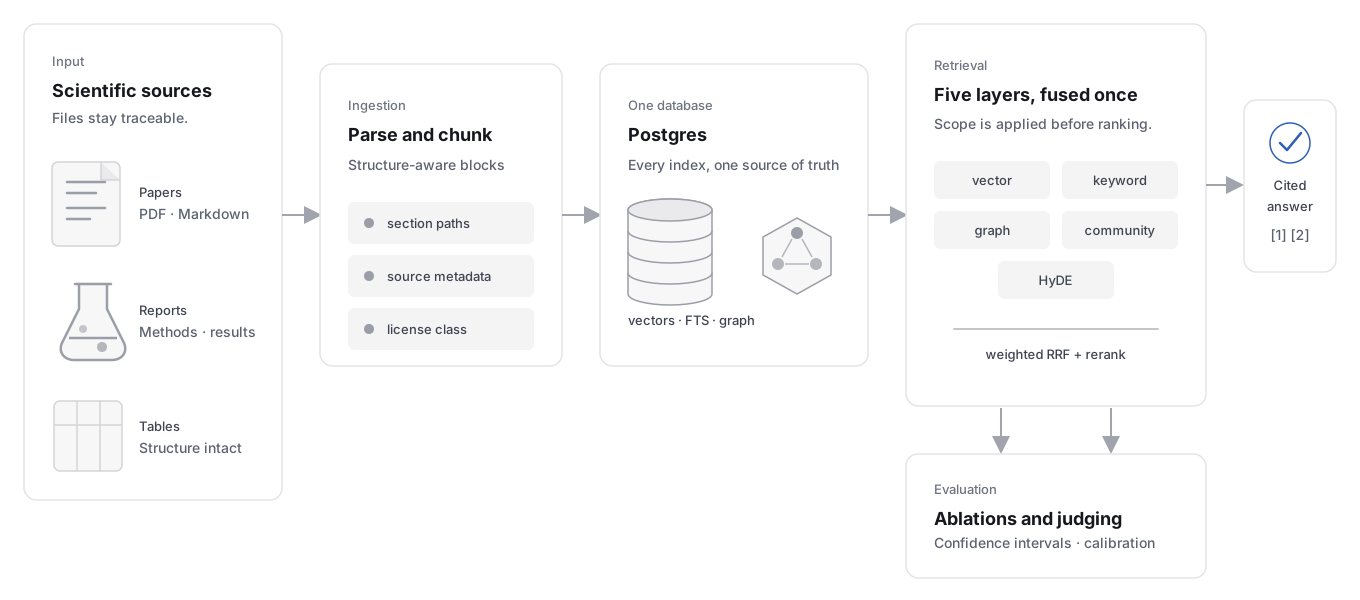
- Structure-aware ingestion
- PDF, Markdown, and text become chunks that retain section paths and intact tables. Follow ingestion into storage.
- Five-layer retrieval
- Vector, keyword, graph, community, and HyDE candidates meet in one weighted fusion. See the retrieval design.
- Postgres-native graph
- Vectors, full-text search, concepts, relationships, and source records live together. Read the decision record.
- Rights-aware scope
- License and metadata filters are enforced inside every eligible layer before ranking. Trace the rights contract.
- Cited answers
- Every answer is assembled from numbered evidence, with a refusal when nothing is in scope. Use REST or MCP.
- Evaluation
- Ablations, confidence intervals, blind judging, calibration, and corpus fingerprints turn quality claims into artifacts. Evaluate your pipeline.
One repository, specialized
The generator configures; it does not template. sci-rag-new fetches this repository at a pinned tag and rewrites its configuration files in place. There are no placeholders to render, and nothing that only becomes real code after generation. The repository you can read is the application you run, before and after.
pipx install sci-rag-kit, the GitHub template button, and a plain clone all leave you with the same tree.
domain/ is the specialization surface: ontology, prompts, retrieval tuning, and evaluation questions. The rest of the tree stays ordinary Python that you can inspect, test, and change.
your-sci-rag/
├── domain/ ontology, prompts, eval questions
├── data/ your source documents and manifests
├── src/sci_rag/ ingestion through serving
├── migrations/ Postgres and pgvector schema
├── tests/ offline unit and integration evidence
├── infra/terraform/ optional Cloud SQL and Cloud Run
└── docs/ methods, guides, API, decisionsWhere to start
Design principles
- Preserve provenance
- Source identity and section context survive ingestion, ranking, and citation.
- Fail closed on rights
- An empty license allowlist returns nothing. Unknown never means safe.
- Make degradation visible
- A timed-out layer becomes a trace, not a quietly weaker answer.
- Earn complexity with evidence
- Retrieval changes ship behind an ablation and stay only when measured.
No cache fleet, plug-in framework, graph sidecar, or hidden agent loop sits behind the quickstart. The defaults stay small enough to describe in a methods section. Read the methodology · See the extension seams
Example
The session above, in full. scripts/render_cast.py builds it by driving the real wizard, so it cannot drift from what sci-rag-new actually asks. Regenerate with make cast. make docs fails if you forget.
$ pipx install sci-rag-kit
$ sci-rag-new
project_name (My Scientific KB): Membrane Materials KB
repo_name (membrane-materials-kb):
description (A short description of your domain.): Membrane chemistry and performance for water treatment
author_name (Your name, lab, or organization): Berkeley Lab
contact_email (Sent to OpenAlex, Crossref, and Unpaywall): you@lbl.gov
python_version (3.12):
Select environment_manager
1 - uv
2 - pixi
3 - conda
4 - venv+pip
Choose from [1/2/3/4] (1): 2
Select dependency_file
1 - pyproject.toml
2 - pixi.toml
Choose from [1/2] (1):
Select credentials
1 - google_ai_studio
2 - vertex_ai
3 - offline
Choose from [1/2/3] (1): 1
Select embedding_provider
1 - google
2 - local-hash
Choose from [1/2] (1):
llm_model (gemini-2.5-flash):
embedding_model (gemini-embedding-001):
embedding_dim (1536):
Select ontology
1 - draft_with_llm
2 - keep_demo_example
3 - blank
Choose from [1/2/3] (1): 1
Select corpus_source
1 - local_files
2 - openalex_topic
3 - doi_list
4 - demo_only
Choose from [1/2/3/4] (1): 2
openalex_topic (your topic): polyamide membrane fouling
max_results (100): 250
Select pdf_parser
1 - pypdf
2 - docling
Choose from [1/2] (1): 2
Select reranker
1 - none
2 - llm
3 - local_cross_encoder
Choose from [1/2/3] (1):
Select include_terraform
1 - Yes
2 - No
Choose from [1/2] (1): 2
Select include_demo_corpus
1 - Yes
2 - No
Choose from [1/2] (1): 2
Select open_source_license
1 - BSD-3-Clause
2 - MIT
3 - Apache-2.0
4 - No license file
Choose from [1/2/3/4] (1):
Select initialize_git
1 - Yes
2 - No
Choose from [1/2] (1):
Select draft_domain_files
1 - Yes
2 - No
Choose from [1/2] (1):
Drafting an ontology for "Membrane chemistry and performance for water treatment"...
Entity types Membrane, Material, Contaminant, Process, Property, Application, Organization, Standard
Relation types MADE_OF, REMOVES, HAS_PROPERTY, USED_IN, REQUIRES, COMPARED_WITH
Query classes performance, fabrication, fouling, application
Accept this ontology? [y/n/redraft] (y):
Fetching sci-rag-kit for membrane-materials-kb...
Writing membrane-materials-kb/
removed docs/planning/, infra/terraform/, data/demo/, examples/
domain/domain.yaml 8 entity types, 6 relation types, 4 query classes
domain/eval_seed_questions.jsonl guided blank
.env google_ai_studio, gemini-2.5-flash, gemini-embedding-001
pyproject.toml name, description, extras: docling
Makefile commands prefixed with `pixi run`, database runs from conda-forge, no Docker
docs/ kit onboarding, player, and cast removed
pyproject.toml [tool.pixi] workspace, environments, tasks
Dockerfile pixi base image
.devcontainer/ ghcr.io/prefix-dev/devcontainer-features/pixi:0
rendered 8 files for pixi
pixi.lock created on first `pixi install`
data/campaigns/ openalex topic "polyamide membrane fouling"
LICENSE BSD-3-Clause
README.md rewritten opening
git initialized, 1 commit
Done. Membrane Materials KB is yours. Next:
cd membrane-materials-kb
pixi install
pixi run sci-rag doctor
make corpus